


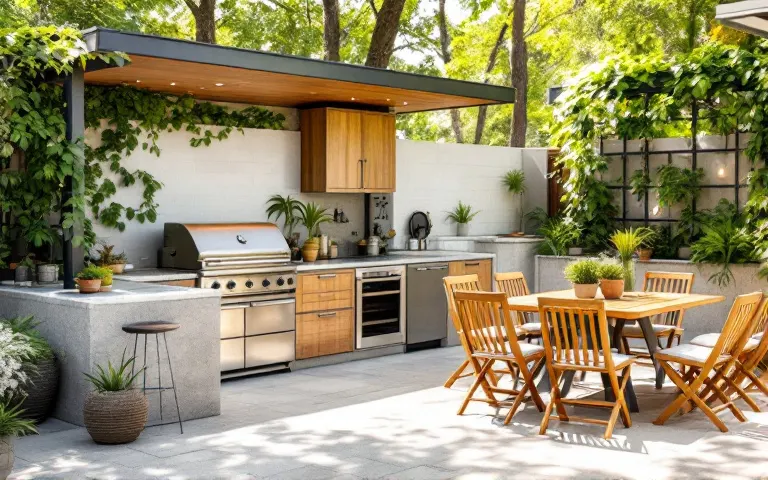
Outdoor living psychology

20 years of experience as a home decor consultant, specializing in furniture selection, space-conscious layouts, and practical interior solutions.
There’s a reason a few summer outdoor kitchens feel magnetic, while others feel strangely forgettable.
Same budget. Same furniture. Same decor trends.
But one space pulls people in, keeps them lingering, talking longer, eating slower, while another gets ignored after ten minutes.
It’s not tasty.
It’s biology.

Most summer outdoor decor advice focuses on aesthetics, colors, materials, and layouts. But beneath all of that sits something far more powerful: how the human brain interprets safety, reward, and belonging in an outdoor environment.
And once you see it, you can’t unsee it.
Here are five rare, science-backed truths about outdoor kitchen decor that reshape how space influences behavior, emotion, and connection.
The Brain Doesn’t See Decor, It Detects Survival Signals

Truth: Every outdoor kitchen is subconsciously judged as either safe or draining within seconds.
Neuroscience layer: The brain’s threat-detection systems constantly scan environments for danger cues. Sharp contrasts, chaotic layouts, or overly exposed seating can create low-level stress. Soft edges, layered textures, and partial enclosure help the nervous system relax.
Psychological layer: The body reacts first, and the mind invents a reason after.
Philosophical shift: Outdoor kitchen decor is not decoration. It is a nervous system design. You are not styling a space. You are shaping how safe people feel inside it.
Practical shift: Use partial boundaries such as pergolas, plants, and soft-light zones to create a sense of refuge without closing off the space. This is why the best summer outdoor kitchen ideas always feel slightly “held,” not exposed.
Warm Lighting Isn’t Cozy, It Changes Chemistry

Truth: The right lighting does more than set a mood. It changes how long people stay and how deeply they connect.
Biological layer: Warm, low-intensity lighting helps the brain stay calm and socially open. Harsh, cool lighting pushes the body toward alertness and task mode rather than conversation and rest.
Psychological layer: People linger where time feels slower. Warm lighting softens urgency and makes conversation feel fuller, richer, and less rushed.
Philosophical shift: Lighting is not about visibility. It is about permission. Permission to slow down, open up, and remain a little longer.
Practical shift: String lights for overhead warmth, low lanterns for eye-level glow, and subtle indirect lighting to eliminate harsh shadows. This transforms a basic outdoor kitchen decor setup into an experience people don’t want to leave.
|
MUST READ: |

Natural Materials Speak to Ancient Memory

Truth: Wood, stone, and organic textures do not just look beautiful. They feel biologically familiar.
Neuroscience layer: The brain processes natural patterns like wood grain, stone variation, and plant shapes with less effort than artificial uniform surfaces. What the brain processes easily, it tends to enjoy more.
Psychological layer: Natural textures signal authenticity. Synthetic-heavy spaces may appear polished, yet still feel subtly cold or false.
Philosophical shift: Human beings do not rest most deeply in perfection. They rest in nature’s imperfect order.
Practical shift: Integrate real or convincingly natural materials into your outdoor kitchen ideas – wood countertops, stone accents, linen fabrics. Even small touches create disproportionate emotional impact.
Layout Quietly Decides Who Connects

Truth: The arrangement of an outdoor kitchen silently shapes who talks, who leads, and who fades into the background.
Biological layer: Human brains constantly track spatial position. Circular and semi-circular seating supports eye contact and ease. Scattered or rigidly linear layouts can create subtle competition for attention.
Psychological layer: When people do not have to fight for a place in the conversation, they relax. Energy rises when social space feels shared instead of contested.
Philosophical shift: A space is never neutral. It either creates a connection or quietly fractures it.
Practical shift: Design seating that curves or slightly encircles around a focal point (such as a table or fire feature). The best outdoor kitchen decor ideas don’t just look balanced – they distribute attention evenly.
Scent Is the Invisible Anchor of Memory

Truth: Smell shapes emotional attachment faster than logic ever can.
Biological layer: Scent moves straight into the brain’s emotional and memory systems. That is why herbs, wood smoke, citrus, and grilled food can make a place unforgettable.
Psychological layer: A repeated scent turns into an anchor. People do not only remember the space. They feel drawn back to it.
Philosophical shift: What stays with people is rarely what they saw. It is what they felt before they had words.
Practical shift: Incorporate sensory layering into your outdoor kitchen design: herb planters (basil, rosemary), subtle wood smoke, or even citrus elements. This turns a simple summer outdoor decor setup into a memory engine.
|
MUST READ: |
Why This Changes Outdoor Kitchen Design
Most people design outdoor kitchens to look impressive.
But the spaces that truly work, the ones people return to and talk about, are designed for the brain, not just the eye.
That is the difference between decoration and influence.
Between a space people use and a space people feel.
Every gathering, every long conversation, every moment that stretches into the night is shaped by invisible forces most people never notice.
Ignore them, and even expensive setups can feel empty.
Use them, and even simple outdoor kitchen decor can become magnetic.
The Cost of Getting It Wrong (And Why It Matters Now)
Outdoor living is no longer seasonal – it’s becoming a core extension of how people host, connect, and unwind.
Which means expectations are rising.
People may not articulate why a space feels good or bad, but they act on it instantly.
They stay. Or they leave.
They open up. Or they scroll their phones.
They come back. Or they don’t.
That’s not a preference.
That’s programming.
The Smart Next Step
Stop thinking like a decorator.
Start thinking like a behavioral designer.
- Build for safety signals, not just style.
- Use lighting to control emotional tempo.
- Anchor the space in natural materials.
- Shape interaction through layout.
- Layer scent to lock memory into place.
Do this, and the space stops being something people merely see.
It becomes something they feel and want more of.
And that is what makes it unforgettable.




Add comment