


Fix outdoor decor mistakes

20 years of experience as a home decor consultant, specializing in furniture selection, space-conscious layouts, and practical interior solutions.
I walked into a client’s backyard in Phoenix two summers ago and knew immediately what was wrong. Beautiful furniture, good bones, real money spent.
But the rug was too small, every pot was the same height, and the only light source was a single overhead fixture that made the whole space feel like a gas station forecourt after dark. Three fixes, one afternoon, and the same backyard looked like it belonged in a shelter magazine.
None of those outdoor decor mistakes was obvious to her. That’s the thing about outdoor decor errors – they’re usually invisible until someone names them. So here they are, named. Read through and see how many land.
Mistake #1: The Rug Is Too Small

Walk into any outdoor space that feels vaguely wrong and check the rug first. Ninety percent of the time, it’s undersized. A 5×8 floating in the middle of a patio with furniture legs hanging off the edges doesn’t define a room – it just looks like someone put down a bath mat and called it done.
The fix is simple, if slightly counterintuitive: size up dramatically. An 8×10 is the floor for most standard patio seating groups, and a 9×12 works better than you’d think in larger spaces. All front legs of all seating should sit on the rug.
That proportion is what signals “designed room” to the brain rather than “concrete slab with stuff on it.” Outdoor rugs in the 8×10 range run $65-$120 at Wayfair or Amazon and are worth every cent as the single most impactful change you can make.
The caveat: avoid tight-weave rugs in areas with poor drainage. Moisture trapped underneath breeds mildew faster than you’d believe.
Mistake #2: Every Plant Is the Same Height

Picture a row of matching terracotta pots, all 10 inches tall, lined up along a fence. Tidy. Boring. Dead in the eyes. Plants at a single height read as decoration rather than design, and the difference between a patio that feels alive and one that feels flat is almost always vertical variation.
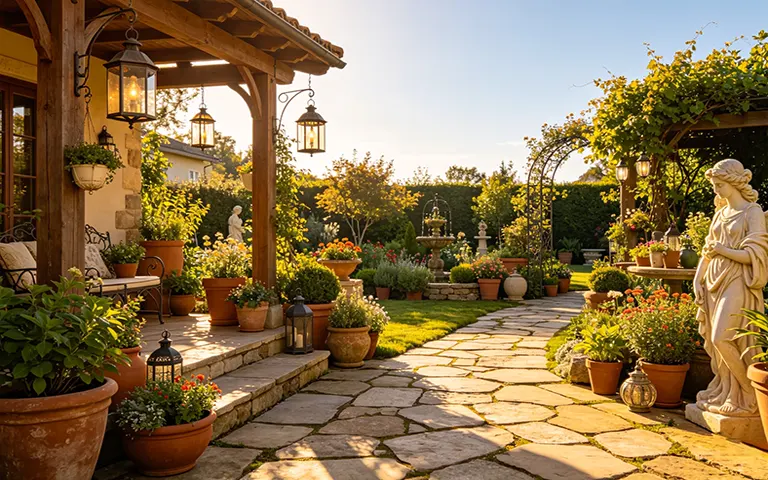
The fix is grouping at three levels: low (ground-level planters and trailing plants spilling over pot edges), mid (tabletop containers, shepherd’s hook planters, window boxes mounted on fencing), and high (hanging baskets, tall ornamental grasses, or a climbing vine on a trellis).
You don’t need to replace what you have – often just adding one tall specimen plant ($15-$25 for a decent ornamental grass at most nurseries) and one hanging basket creates the layering that changes the whole read of the space. Your eye starts traveling up and down rather than skating across a flat line.
|
MUST READ: |
Mistake #3: One Light Source After Dark

Before I get into furniture and plants, I want to spend a moment on the lighting mistake because it’s the most punishing one on this list. A single overhead fixture – pendant, flush mount, whatever – is a functional light source. It is not a mood. It’s the difference between a kitchen and a restaurant, and everyone knows which one they’d rather eat in.
Designers layer outdoor lighting the same way they layer it inside: ambient overhead (your existing fixture or string lights in a canopy grid), mid-height accent (lanterns on tables and mounted on fence hooks), and low ground-level glow (solar path lights, uplighting for plants or architectural features).
Edison-style string lights from Amazon in the $25-$40 range handle the ambient layer on their own. Add two matte-black lanterns at $18-$28 each from Wayfair for the mid layer, tuck a few solar ground stakes into planter beds, and the same patio you’ve been eating dinner on for years suddenly looks like somewhere worth staying after the meal.
Mistake #4: The Color Palette Is Having an Argument

Terracotta pots next to a turquoise umbrella next to sage-green cushions next to a navy-striped throw. None of those are bad colors individually. Together, they make your patio look like a clearance bin at a garden center. The eye has nowhere to settle. Everything fights for attention, and nothing wins.
Pick two or three colors, then hold the line. A neutral base (warm sand, slate gray, natural wood tones) plus one accent color repeated in at least three places creates cohesion that reads as intentional. Dusty sage repeated in the throw pillow, a pot, and a planter looks like someone made a choice.
It doesn’t take more money – it takes discipline when you’re standing in the aisle at Target surrounded by sixteen shades of outdoor cushion cover that all look fine in isolation.
Mistake #5: Buying only Matching Sets

Honestly? Matching outdoor furniture sets is one of the easiest ways to make an expensive patio look cheap. Everything is the same material, the same finish, the same line – it looks like a showroom floor, not a lived-in space. The patios that feel genuinely personal almost always have at least one piece that breaks the pattern.
The fix isn’t throwing out your existing set. It’s adding one thing that doesn’t match. A teak side table next to powder-coated metal chairs. A woven rattan accent chair pulled into a space with an aluminum sectional. A vintage wooden stool sealed with exterior poly as a plant stand.
The mismatched piece is the one guests ask about, which is exactly what you want. I’m still not entirely sure why this works so reliably, but after styling dozens of outdoor spaces, it does, every single time.
Mistake #6: Ignoring the Fence

A bare wooden fence is a missed opportunity on a scale most people never reckon with. It’s the largest vertical surface in most backyards, and leaving it as a plain brown wall while spending money on ground-level decor is like framing a room with bare drywall and wondering why it feels unfinished.
You don’t need to build a living wall or hire anyone. A set of wall-mounted planters (4-pack for $30-$50 on Amazon) in a staggered grid with trailing plants adds living texture in a month. A large-format outdoor mirror bounces light, making the yard read as deeper than it is.
A simple trellis panel with climbing jasmine or even fast-growing annual vines costs $20-$35 and creates a backdrop that makes every photo taken in your backyard look like it was shot somewhere intentional.
|
MUST READ: |
Mistake #7: Forgetting the Welcome Moment

The first two seconds someone spends stepping into your outdoor space determines how they experience everything that follows. And most people neglect that threshold entirely. The back door opens onto a coiled hose, a sad doormat, and maybe a forgotten pair of gardening gloves. Not exactly an invitation.
Two matching planters flanking the back door – even simple terracotta with something full and green – plus a mat that has actual visual personality, plus a wall-mounted lantern on one side: that’s $60-$80 total, and it reframes the entire entry point.
The rest of the patio can be identical to what it was, but it lands differently because it was announced properly. Think of it the way you’d think about a restaurant entrance versus a back-of-house door. Same building. Wildly different first impression.
Mistake #8: Cool-White String Lights

They’re everywhere, and they all look wrong outdoors. Cool-white LED string lights (4000K-6500K color temperature) turn skin tones gray, make food look unappealing, and create the ambiance of a hardware store. Warm white or amber (2200K-2700K) does the opposite – it makes everything golden, flattering, and genuinely inviting after dark.
The packaging will say “daylight” or “cool white” or give a Kelvin number above 3000. Avoid all of those outdoors. Stick to “warm white,” “soft white,” or any Edison-style bulb, which is almost always in the right color temperature by default.
The price difference between warm and cool is nothing. The difference in atmosphere is everything. A $30 strand of the right bulbs creates an effect that cool-white lights at any price simply can’t.
Mistake #9: Over Decorating (Then Never Editing)

Adding more is the natural response when a space isn’t working. More plants, more lanterns, more throw pillows, more decorative objects on every flat surface. The result is a patio that feels busy and anxious rather than relaxed and designed. More isn’t the solution to a space that isn’t working – clarity is.
Take everything off every surface and off the floor, then bring things back one by one, deciding each time whether it earns its place. If something is there only because it has nowhere else to go, that’s not a reason.
A storage bench with a hinged lid ($55-$80 on Amazon) solves the where-does-it-go problem for hoses, extension cords, and extra cushions while doubling as seating. Edit ruthlessly. The spaces that photograph well are rarely the full ones.
Mistake #10: No Focal Point

Walk into a yard that feels pleasant but forgettable, and there’s usually no answer to the question: what is this space about? Nothing draws the eye. Everything is equally weighted and equally uninteresting. A good outdoor space has one element that anchors the whole setup – something your eye finds first and returns to.
It doesn’t have to be expensive. A fire bowl from Frontgate ($60-$90) becomes a gathering point and a visual anchor. A large ceramic pot with a striking plant. A piece of outdoor wall art on the fence. A concrete water feature with a small recirculating pump ($45-$75 on Amazon).
Pick one thing to be the thing, and arrange everything else around it. The focal point is what gives a space a reason to exist beyond “place to sit when the weather is nice.”
Key Takeaways
- Size up your outdoor rug to at least 8×10 and seat all furniture legs on it – this single fix does more for how a patio reads than almost any other change.
- Layer lighting at three levels (overhead, mid-height, ground) using warm amber bulbs only – cool-white LEDs outdoors create a hardware-store atmosphere that no amount of good furniture overcomes.
- Vary plant heights across at least three levels: low trailing plants, mid-height pots and boxes, and at least one tall vertical element. A flat row of the same-height pots reads as decoration rather than design.
- Commit to two or three outdoor colors maximum and repeat your accent color in at least three places – cohesion comes from restraint, not from finding the perfect shade.
- Add one piece that doesn’t match your furniture set; the intentional mismatch is what makes a space feel personal rather than pulled from a showroom floor.
- Edit before you add – removing objects that don’t earn their place has more visual impact than buying new decor for a cluttered space.
- Every patio needs one focal point that anchors the space; without it, the eye drifts and nothing registers as designed or intentional.
Frequently Asked Questions
Why does my patio look cheap even though I spent money on it?
Usually ,it’s a proportion or cohesion issue, not a budget one. Check for an undersized rug, a fractured color palette with too many competing tones, or cool-white lighting that drains warmth from the space. Fixing those three things – often for under $100 total – changes the read of even expensive furniture dramatically.
What is the most common outdoor decorating mistake?
Using a rug that’s too small. It’s almost epidemic. A 5×7 rug under a full patio seating group makes everything look like it was placed accidentally rather than arranged on purpose. Sizing up to an 8×10 or larger, with furniture legs sitting on the rug, is the single fastest fix in outdoor decorating.
How do I make my outdoor space look more cohesive?
Commit to a palette of two neutrals plus one accent color, then repeat the accent in at least three places (a pillow, a pot, one decor object). Remove anything that doesn’t fit the palette, even if it’s a piece you like. Cohesion comes from editing, not adding. The discipline of holding the line is what separates styled from assembled.
Is it bad to buy a matching outdoor furniture set?
Not bad – just limiting. Matching sets tend to look like a showroom display rather than a personal space. Break the monotony by adding one piece in a different material or finish: a teak side table next to metal chairs, or a woven accent chair in an otherwise solid-framed grouping. That one mismatch is what guests remember.
How do I add a focal point to my backyard?
Pick one thing to be “the thing” – a fire bowl, a large planted pot, a wall feature, a water element – and place it where the eye naturally lands when you first step outside. Then arrange everything else in relation to it rather than treating every element as equally important. A fire bowl from Target runs $60-$90 and works in almost any size yard.
|
MUST READ: |

Conclusion
Pick the one mistake on this list that hit hardest – the one where you thought “that’s exactly my patio” – and fix just that one thing this week. Not all ten. One. The rug size is usually the fastest to fix and the most immediately obvious in its impact, so if you’re unsure where to start, that’s the one. Measure your current rug, then go one size up. You’ll know within five minutes of laying it down whether the rest of the space shifts with it.
Once one fix is in place, the others become easier to see and easier to sequence. That’s how every space I’ve turned around has worked: not a full overhaul but a series of single, deliberate decisions made one at a time. If one of these fixes surprises you, drop it in the comments – I’m always curious which mistake people most didn’t know they were making.
And if you’re starting from scratch, our guide to outdoor decor ideas that make any backyard look expensive picks up right where this one leaves off.




Add comment