



High-end outdoor styler

20 years of experience as a home decor consultant, specializing in furniture selection, space-conscious layouts, and practical interior solutions.
A few years back, I was hired to style two backyards in the same week. One client had spent close to $8,000 on an outdoor furniture collection from a high-end retailer. The other had a $1,200 budget, total. The first space looked expensive but oddly flat – everything matched too perfectly, the lighting was a single ceiling-mounted fixture, and there wasn’t a plant in sight. The second space drew more compliments by the time we finished, at every gathering that summer.
The difference wasn’t money. It was understanding which design decisions actually read as luxury and which ones are just expensive. Luxury outdoor living spaces comes from texture, layered light, natural materials, and the feeling that someone made deliberate choices. None of those things requires a large budget. They require knowing where to put what you have.
Here are the secrets. The ones I apply,y whether a client has $500 or $5,000 – because the principles don’t change, only the price points of the materials.
Start With Lighting That Has Three Layers

Nothing signals luxury in an outdoor space faster than good lighting – and nothing undermines it faster than a single overhead fixture doing all the work. Hotel courtyards, resort pools, high-end restaurant terraces: they all use layered light. Ambient overhead, mid-height warmth, and low ground-level glow work together. That combination is what makes a space feel like somewhere you’d pay to sit.
The overhead layer is easiest. A 50-foot strand of warm Edison-style string lights (2200K color temperature, not cool white) hung in a canopy grid costs $25-$75 on Amazon and changes the entire character of a patio after dark.
Mid-height comes from lanterns on tables and fence-mounted sconces – matte black lanterns from Wayfair run $30-$180 each (depending on the model you choose) and look genuinely considered placed in pairs or threes.
Ground-level lighting is solar uplighting tucked into planter beds or stake lights along a path, which you can find at Home Depot for $15-$30 per pack of six. All three layers together cost under $120 and produce an effect that no amount of expensive furniture replicates on its own.
One hard rule: warm bulbs only. Cool-white LEDs outdoors make everything look institutional. Warm white or amber makes everything look golden. The packaging will say “warm white” or list a Kelvin number below 3000K. Anything above that stays inside.
|
MUST READ: |
Choose One Genuinely Good Anchor Piece

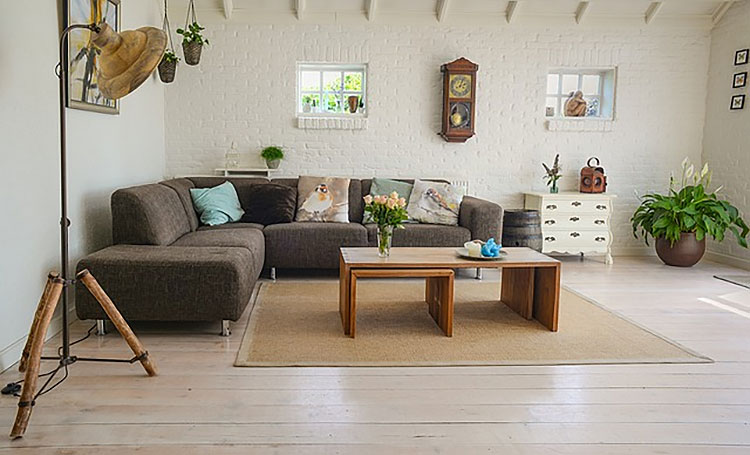
Luxury doesn’t come from buying everything at a premium. It comes from buying one thing at a premium and surrounding it with smart, lower-cost supporting pieces. I call it the anchor-and-layer method, and it’s how I approach almost every outdoor space, regardless of budget.
The anchor piece should be the thing people see first and return to visually, usually the main seating element or the dining table. For a lounge-focused space, a quality teak or powder-coated aluminum sofa frame with good bones ($400-$700 at Frontgate or West Elm Outdoor) will look beautiful for fifteen years with minimal care.
For a dining-focused space, a solid teak or concrete-top dining table ($350-$600 at Wayfair or CB2) becomes the visual cornerstone around which everything else is arranged. Buy the anchor piece well.
Then be more relaxed about what surrounds it – accent chairs from Target’s Threshold line ($80-$130 each), side tables from Amazon ($35-$55), and a storage bench that pulls double duty. The anchor piece carries the luxury read. The supporting pieces need not fight it.
|
MUST READ: |

Natural Materials at Every Price Point

Plastic reads as temporary. Powder-coated metal reads as functional. But teak, stone, terracotta, rattan, concrete, and jute read as luxury at almost any price point. And here’s what most people don’t realize: you don’t need much of them. One or two natural-material elements in an otherwise budget-minded outdoor space shift the entire impression of what the space is about.
A set of three terracotta pots in varying sizes – $4, $8, and $14 at any nursery – painted in a single matte tone with a $12 can of Rust-Oleum Chalked spray looks like something from a Scottsdale boutique garden shop.
A jute or natural-fiber outdoor rug ($65-$100 at Wayfair) underfoot adds haptic richness that polypropylene print rugs don’t have. A teak cutting board used as a serving tray on the coffee table, a concrete candle holder, a woven rattan planter liner – none of these individually cost much.
Together, they communicate that the space was put together by someone who cares about material quality, which is exactly what luxury reads as.
I know what you’re thinking: isn’t terracotta going to crack in a Minnesota winter? Yes. Bring them in. The plants need to come in anyway, and the pots stack. Worth the trade-off for nine months of something that looks genuinely good.
Invest in the Textiles, Not the Frames

Most outdoor furniture is sold with cushions that are functional at best and embarrassing at worst – thin fill, dull colorways, fabric that starts pilling and fading within a single season. The frames – especially aluminum and resin wicker – are usually fine and will last for years. The cushions are the problem, and they’re also the easiest and most impactful thing to upgrade.
Sunbrella fabric is the material standard for outdoor textiles that actually hold up. It’s solution-dyed (the color goes all the way through the fiber, not just on the surface), mold-resistant, and UV-stable in ways generic polyester isn’t.
Sunbrella cushion covers run $30-$160 each at Pottery Barn or Wayfair – more than the covers that came with your furniture, and worth every extra dollar across two or three seasons of real use. Add two 22×22 outdoor throw pillows per seating surface in a coordinating pattern, and suddenly a $400 furniture set reads like a $1,200 one. The textiles are doing the work. Let them.
Create an Outdoor Room With Boundaries

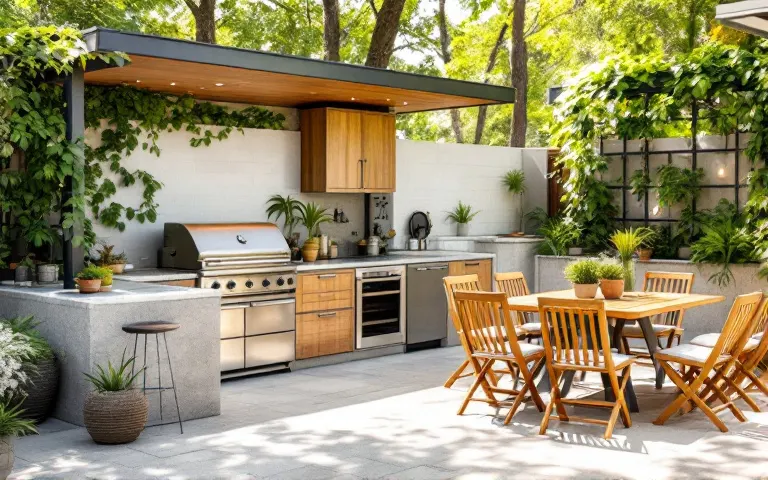
Luxury outdoor spaces feel like rooms. Not like patios with furniture on them – actual rooms, with defined edges, a sense of enclosure, and a reason your eye stops traveling and settles. Creating that feeling doesn’t require walls. It requires implied boundaries: a rug that defines the floor plane, a pergola or shade sail that creates a ceiling, and vertical elements (planters, screens, trellises) that establish the sides without fully closing them off.
A shade sail in warm cream or neutral tan, tensioned across three anchor points, costs $45-$70 for a 12×12 size on Amazon and creates an overhead structure that makes the whole space feel considered and sheltered.
A row of tall planters with ornamental grasses along one edge of a patio creates a soft green wall that costs maybe $80 total (three large pots, three grasses) and does more for the feeling of the space than a $500 privacy fence panel. The goal is a sense of being in a place rather than on a surface. That distinction is the whole game.
|
MUST READ: |
The Details That Read Expensive (and Don’t Cost Much)

After the anchor pieces and the lighting are in place, luxury lives in the details. Small things that communicate care and intentionality. A tray on the coffee table with three objects on it – a candle, a small succulent, and a river stone – looks styled. The same table with nothing on it looks empty; the same table with seven random things on it looks cluttered. Three is almost always the right number.
Outdoor candles in hurricane lanterns, not just pillar candles left exposed to wind. A throw blanket in a natural fiber (outdoor-rated cotton or acrylic) folded over the arm of a chair rather than draped carelessly.
A small herb planter on the dining table – basil, rosemary, thyme – that smells like something real and alive every time the breeze moves. Water in a decorative bowl with a floating candle. None of these costs more than $20 individually.
Together they create the sensory richness that’s actually what luxury feels like: the sense that multiple things are happening at once, all of them pleasant, none of them accidental.
Honestly? The single detail I most often see missing in outdoor spaces that look almost-but-not-quite luxurious is scent. Fresh herbs, a citronella candle that smells decent, and a jasmine vine trained up a fence near the seating area. The nose registers luxury as much as the eye does. Don’t neglect it.
Shop Backward – Off-Season, Clearance, and Secondhand
A luxury outdoor space on a real budget requires shopping like a stylist, not like a regular consumer. Stylists buy off-season, shop clearance sales aggressively, and know that a $90 teak side table from Facebook Marketplace, sanded and re-oiled, looks identical to the $400 version from a retailer.
Late July through September is when most major retailers (Home Depot, Target, Wayfair, Pottery Barn) begin marking outdoor furniture and decor down for end-of-season clearance. Discounts hit 40-70% by mid-August.
That Threshold outdoor sofa, $349 in May, becomes $129 in August. Buy for next season, store it, and stretch your budget by a factor of two or three. Facebook Marketplace and Craigslist are full of high-quality teak and aluminum furniture from people who are moving or upgrading – teak especially holds up so well that a five-year-old set cleaned and re-oiled is indistinguishable from new.
A $300 secondhand teak dining set, re-oiled with a $15 can of teak oil, looks better than a $600 new set made of a lesser material. That’s the math.
Key Takeaways
- Layer outdoor lighting at three levels – overhead string lights, mid-height lanterns, and low ground stakes – using warm amber bulbs only. All three layers together cost under $120 andeliveror a luxury feel better than any furniture upgrade.
- Buy one genuinely high-quality anchor piece (a teak table, a well-framed sofa) and surround it with smart, lower-cost supporting pieces. The anchor carries the luxury read; the rest need not fight it.
- Introduce natural materials – terracotta, teak, jute, rattan, concrete – even in small amounts. One or two natural-material pieces shift the entire impression of a space more than any amount of budget furniture in synthetic materials.
- Replace stock cushions with Sunbrella fabric covers ($30-$160 each at Pottery Barn or Wayfair). The textile upgrade turns a $400 furniture set into something that reads at twice the price.
- Create an implied room with a rug underfoot, overhead structure (shade sail or pergola), and vertical planting elements on at least one side. The feeling of being in a place, rather than on a surface, is the very definition of luxury outdoors.
- Shop clearance in late July through September when outdoor furniture goes 40-70% off, and check Facebook Marketplace for secondhand teak – a re-oiled five-year-old teak set looks identical to new.
- Style the coffee and side tables in threes: one candle, one plant, one object. That level of curation signals care and intentionality – the detail work is where luxury actually lives once the big pieces are in place.
|
MUST READ: |
Frequently Asked Questions
How do I make my backyard look luxurious on a budget?
Start with lighting – three layers in warm amber tones cost under $120 and create more atmosphere than expensive furniture. Add one natural-material anchor piece, upgrade your cushions to Sunbrella fabric, and introduce terracotta or teak in small doses. Luxury reads as intentionality, not price. Edit ruthlessly: a spare, considered space always reads more expensive than a full, cluttered one.
What outdoor furniture materials look most luxurious?
Teak and powder-coated aluminum consistently read as high-end regardless of actual price. Teak weathers beautifully, ages with character, and immediately signals quality. Concrete and stone surfaces on tables add weight and materiality that plastic never achieves. Even one piece of teak or stone in an otherwise modest setup can significantly shift the overall impression of the space.
How much does it cost to create a luxury outdoor space?
You can get a genuinely high-end-looking outdoor space for $500-$800 if you shop smart: one quality anchor piece bought off-season or secondhand, a layered lighting setup under $120, natural-material details in terracotta and jute, and upgraded cushion covers. The spaces that look like $3,000 setups often cost $700-$900 in well-placed, well-timed purchases.
What makes an outdoor space feel luxurious?
Layered warm lighting, natural materials, a defined sense of enclosure (rug underfoot, overhead structure, vertical greenery on one side), quality textiles, and styled surfaces with thoughtful objects in groups of three. Scent matters too – fresh herbs or climbing jasmine near the seating area register luxury through the nose as much as the eye.
Where is the best place to buy outdoor furniture on a budget?
Off-season clearance at Amazon, Target, CB2, and Wayfair (July-September, 40-70% off). Facebook Marketplace for secondhand teak – it holds up so well that older pieces re-oiled look new. HomeGoods for natural-material accents that cycle through seasonally at low prices. Wayfair and Pottery Barn for Sunbrella cushion covers, especially at the end of the season when they discount heavily.
Conclusion
Start with the lighting tonight. Seriously – order one 50-foot strand of warm Edison-style string lights from Amazon ($25-$75), hang it tomorrow over whatever seating area you have, and eat dinner outside under it that same evening. Before any anchor piece is bought, before any rug is laid down, before a single cushion is replaced, do that one thing and feel how completely the space changes after dark. That experience tells you everything you need to know about why luxury in outdoor spaces is really a question of atmosphere, not investment.
From there, the anchor piece. Then the natural materials. Then the textiles. Build it in layers over a season if you need to – no rule says it all happens at once. The best luxury outdoor living spaces I’ve ever worked on were built incrementally, each addition living in the space for a few weeks before the next one arrived.
That pace is what creates rooms that feel genuinely personal rather than assembled from a single shopping trip. If you’re ready to dig into the specifics of what to buy, our guide to outdoor decor ideas that make any backyard look expensive covers every category with price points and retailer recommendations for exactly this kind of build.




Add comment