
Easy layout fixes

20 years of experience as a home decor consultant, specializing in furniture selection, space-conscious layouts, and practical interior solutions.
What about the apartment decorating mistakes you need to avoid? The first thing I always notice when I walk into someone’s first apartment isn’t what they bought. It’s what they got wrong about scale. A tiny rug sitting like a postage stamp in the middle of a living room. A sofa pushed flat against the wall.
One bare bulb overhead doing the exhausting work of lighting an entire room. I’ve been styling spaces for over a decade, and I can spot a first-timer’s apartment from the doorway – not because the furniture is cheap, but because nobody ever told them the rules.
And that’s the thing. Most of these mistakes aren’t about money. You can make every single one of them while spending thousands at West Elm. They’re about assumptions – the kind that feel logical until you actually live with them.
So here’s what actually goes wrong. Not the vague stuff. The specific, avoidable, fix-it-today mistakes that make a first apartment feel half-finished even when the furniture is all in place.
The Rug Is Almost Always the Wrong Size
Buy bigger than you think. Then go one size up from that. I’ve given this advice hundreds of times and people still come back to me six months later with a 5×7 rug sitting under a coffee table like it got lost.
Here’s what happens: you stand in a store (or scroll Wayfair at midnight), and the 5×7 looks enormous. Then you get it home and suddenly your sofa, your armchairs, your coffee table – none of it is on the rug. The front legs of your sofa float somewhere above the edge. It looks provisional. Like you’re still deciding whether to stay.
In a standard apartment living room, you almost always need an 8×10, and often a 9×12. At minimum, the front legs of every major seating piece should rest on the rug. Ideally all four legs sit on it. You’ll find solid 8×10 options for $120–$250 at Rugs USA, Amazon, or Target – you don’t need to spend $600 to get this right. You just need to not go small.
Every Piece of Furniture Is Against the Wall
Pull it in. Even six inches makes a difference.
I know it feels counterintuitive – especially in a small space, where the instinct is to push everything to the edges to “create room in the middle.” But what you actually create is a room that feels like a waiting area. Furniture clustered against walls leaves a dead zone in the center and makes conversation weirdly formal, like everyone is slightly too far from each other.
Try floating your sofa a foot or two off the wall. Put a small console table behind it if that gap bothers you. Suddenly the room has a center of gravity. Things feel intentional. The space reads as lived-in rather than arranged.
This works even in tight apartments. A 10×12 living room can handle furniture pulled away from the walls – it just takes trust. And maybe some measuring tape.
The Lighting Is Doing Everything Wrong
Overhead lighting in most apartments is vestigial – technically functional, emotionally devastating. One flat ceiling fixture washing the whole room in the same even glow is how you make a space feel like a break room at a mid-size insurance company.
Real warmth comes from layering. You want light at different heights: a floor lamp in one corner, a table lamp on a side table, maybe something on a console or a shelf. Three sources is a good target. Five is luxurious. One is a mistake.
The other half of this is color temperature. Bulbs matter more than most people realize. Anything above 3000K starts to feel clinical. Stick to 2700K or 2400K warm white bulbs, and that same plain apartment immediately reads cozier. A decent floor lamp runs $45–$90 at Amazon or HomeGoods. You don’t need five of them – but you do need more than one.
Modern summer style does not shout. It suggests.
|
MUST READ: |

Buying Everything From One Store (or in One Trip)
The room that looks like a catalog page is usually the room that feels the least like home. I’m not anti-West Elm – some of my favorite pieces are from there. But when every item in your apartment came from the same collection, in the same finish, at the same time, the result is coherent in a way that feels slightly sterile. Nothing surprises you. Nothing has history.
Mix it up. Buy a few things secondhand. Let a room take six months to finish. The coffee table you find at a flea market in March and the lamp you impulse-bought from Target in June and the throw blanket your aunt gave you – that combination is what actually makes a space feel personal. And mixing price points is smart even for people who can afford not to: a $40 thrifted side table next to a $400 sofa is interesting. Everything at $400 is just expensive.
I’m still not 100% sure why this works as consistently as it does, but rooms that were assembled over time almost always feel more alive than rooms that arrived all at once.
Skipping Art Entirely (or Hanging It Too High)
Blank walls are the most forgivable first-apartment mistake, because art feels like an extra step. You’ve already bought the furniture. You’re tired. The walls can wait.
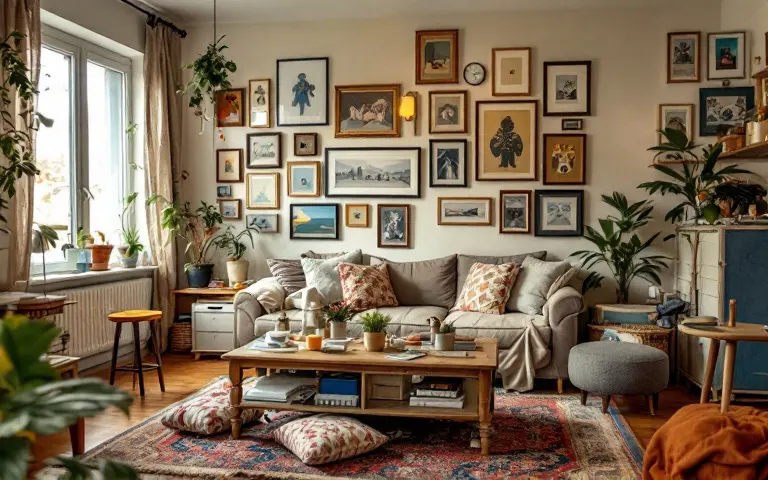
But bare walls are what keep a room from feeling finished, and they’re cheaper to fix than most people think. A gallery wall of thrifted frames and printed photos from Artifact Uprising or Framebridge costs $80–$150 and can completely transform a room. You don’t need original art. You need something with intention.
The more common mistake, though, is hanging art too high. Gallery eye level is around 57–60 inches from the floor to the center of the piece. Most people hang things at standing eye level – 6 feet or higher – and the art floats up near the ceiling, disconnected from the furniture below. Measure before you hammer. One hole in the right place beats three in the wrong ones.
Key Takeaways
- Always buy your rug one size larger than feels necessary – in most apartments, that means an 8×10 minimum, with front legs of all seating pieces resting on it.
- Pull furniture away from the walls. Even 6–12 inches creates a more intentional, conversational layout and makes small rooms feel more designed.
- Replace single overhead lighting with at least three layered light sources at different heights. Use 2700K warm white bulbs for instant coziness.
- Don’t furnish your apartment in a single shopping trip. Rooms built over time – mixing stores, budgets, and sources – almost always feel more personal and alive.
- Hang artwork at 57–60 inches from the floor to the center of the piece, not at standing eye level. Art hung too high loses its connection to the room.
- Thrift shops, Facebook Marketplace, and flea markets aren’t budget compromises – they’re how you add character that new furniture can’t replicate.
- A coherent color palette doesn’t require expensive design help. Pick two anchor colors and one accent. Let everything else be neutral. That’s the whole framework.
|
MUST READ: |
Frequently Asked Questions
What is the biggest decorating mistake in a first apartment?
Buying a rug that’s too small. It’s the most common error and the one that makes everything else look wrong. In most living rooms, you need at least an 8×10 – with the front legs of your sofa and chairs sitting on it. A correctly sized rug ties the whole space together instantly.
How do I make my first apartment feel less like a dorm room?
Layer your lighting, add art at proper eye level, and mix where you shop. Dorm rooms feel temporary because everything is the same height, the same brightness, and from the same place. Even one floor lamp and one secondhand piece can shift the feel significantly.
Should I buy furniture all at once for my first place?
Honestly, no. Buying everything at once tends to produce catalog-looking rooms that feel a little sterile. Start with a sofa, a rug, and lighting. Fill in over time. Rooms built slowly almost always feel more personal than rooms that arrived in a single IKEA haul.
How high should I hang pictures in an apartment?
Center the piece at 57–60 inches from the floor. That’s standard gallery height. Most first-timers hang art at eye level while standing, which puts it too high and disconnects it from the furniture below. Measure once, hang once – your walls will thank you.
What’s the cheapest way to make an apartment feel like home?
Change your light bulbs to 2700K warm white, and add one floor lamp. It costs under $30 and changes everything. After that: a throw blanket, a plant that you won’t kill (pothos, snake plant), and one piece of wall art. You don’t need to spend much to feel the difference.
Final Thoughts
Here’s what I’d tell you to do this weekend: fix the lighting first. Go to Amazon or Target, buy two warm-white bulbs and a floor lamp under $60, and put them in your living room tonight. Don’t do anything else yet. Just stand in that room after dark with the new light on, and notice how different it feels. That’s the version of your apartment you’ve been trying to build without realizing what was missing.
After that, measure your living room and figure out whether your rug is actually the right size (It probably isn’t.) Then pull your sofa six inches away from the wall and sit on it. The room will feel more like yours. These aren’t aesthetic preferences – they’re the fundamentals, the stuff that makes every other decision land right.
If you’ve already made some of these apartment decorating mistakes, that’s fine. Every person who has ever had a great apartment started with a bad one. The difference is just paying attention. Start with the lamp.



Add comment