

Smart decor savings

20 years of experience as a home decor consultant, specializing in furniture selection, space-conscious layouts, and practical interior solutions.
Buying your first home is exciting, but furnishing and decorating it can quickly become overwhelming. After covering the down payment, closing costs, moving expenses, and unexpected repairs, most new homeowners have far less left for decor than they originally planned.
The good news is that creating a stylish, comfortable home doesn’t require buying everything at once. The smartest approach is to focus on affordable, high-impact pieces that make your home feel finished while leaving room for future upgrades.
This guide highlights 15 budget home decor essentials that deliver the biggest visual impact for the money. These are the items interior designers often recommend prioritizing first because they improve comfort, add personality, and make every room feel more complete without stretching your budget.
Buy These First, Everything Else Can Wait
Skip the decorative stuff for now. Before a single throw pillow enters this house, you need the things that make daily life function: a shower curtain and bath mat, a few good towels, basic kitchen tools, and lighting for rooms that don’t already have overhead fixtures. That’s it. That’s the whole first list.
I know it’s tempting to walk into HomeGoods and fill a cart with candles and framed prints on day one. Don’t. You’ll end up buying twice, once for the “fun” stuff and again for the boring essentials you skipped, usually at full price because now you’re desperate.
A floor lamp from Target or Amazon runs $25 to $45 and instantly makes a bare room usable at night. Buy two. Overhead lighting in most starter homes is brutal, a single center fixture throwing flat light across the whole room, and lamps fix that for less than the cost of one throw blanket.
The Living Room, Built in Layers

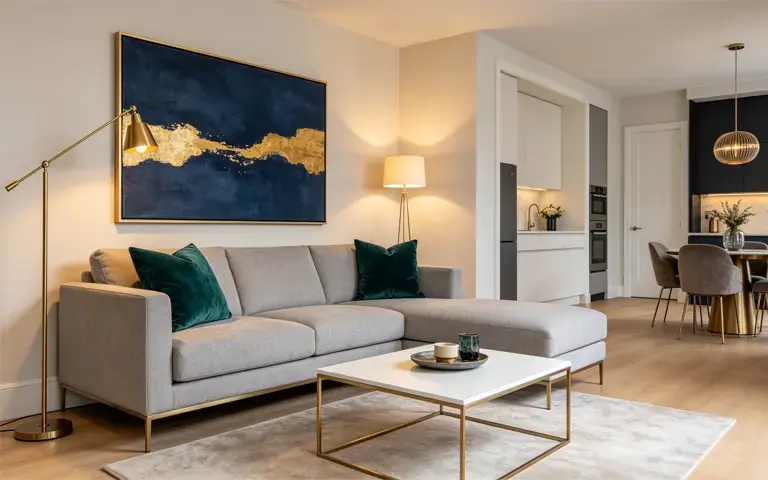
Furnish the living room in this order: seating, a rug, then everything else. A rug isn’t a decoration. It’s what makes a room feel finished instead of half-moved-into, and it’s the piece people skip because it feels optional. It isn’t.
Buy one size bigger than you think you need. This is the one rule I’ll die on. An 8×10 rug in a room that “seems small” will look right the second the furniture sits on it instead of floating around the edges of a too-tiny 5×7.
Budget rugs at Target or Wayfair run $80 to $150 for something perfectly decent, and you won’t need to replace it for years. Save real money by holding off on a coffee table for a month or two. A stack of vintage books or a thrifted trunk works fine as a stand-in, and you’ll actually know what size table you need once you’ve lived in the room a while.
One quick, spontaneous list, since I get asked this constantly, what actually earns a spot in month one:
- A rug (one size up)
- Two lamps
- A sofa or secondhand loveseat
- Curtains, even cheap ones – bare windows read as unfinished
- A mirror, which does more to open up a small space than almost anything else on this list
That’s genuinely most of it. Everything past that is personality, and personality can wait.
|
MUST READ: |
Bedroom Basics That Don’t Break the Bank

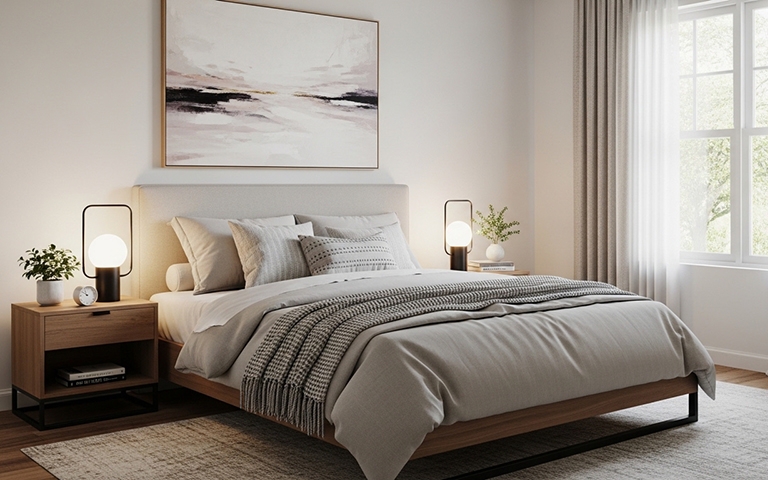
Your bedroom needs less than you think and better sheets than you’re currently buying. Skip the matching bedroom set entirely. Nightstands don’t need to match the bed frame, and mismatched-on-purpose reads as intentional now anyway.
Spend on the mattress and the sheets. Skimp on nightstands. A pair of $45 nightstands from Walmart or Amazon will do the same job as a $300 matching pair, and nobody visiting your bedroom is grading your furniture set for consistency. Cotton sheets with a decent thread count, something in the $50 to $70 range at Amazon, will outperform decorative bedding you’ll want to replace within a year anyway.
Curtains matter more here than in any other room. Blackout curtains are maybe $30 a panel and genuinely change how you sleep, especially if your new house sits under a streetlight the way mine does.
The Kitchen, Without a Full Renovation

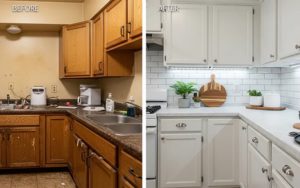
You don’t need new cabinets to make a rental-grade kitchen feel like yours. Open shelving or a simple wall rack ($15 to $25 at Wayfair) does more visual work than you’d expect, especially in a starter kitchen with limited counter space. Hang it at eye level and use it for the dishes you reach for daily, not the fancy stuff you got as a wedding gift.
Cheap tension rods under the sink for organizing cleaning supplies cost about $10 and solve a problem you didn’t know you had until you tried opening that cabinet door. A rolling cart, roughly $30 to $50 at Amazon or Walmart, adds counter space in kitchens that never seem to have enough, and you can move it wherever you need it that week.
Skip the matching dish set for now. A handful of $8 melamine plates from Walmart will survive the first year of unpacking chaos far better than the good china you’re saving for later anyway.
The Bathroom, Small Fixes That Feel Big

You don’t need a bathroom remodel to make the space feel cleaner and more finished. A quality bath mat ($25 to $55 at Walmart) instantly adds comfort and warmth while protecting your floors. Choose something absorbent in a neutral color, and skip the matching toilet seat cover sets that tend to make the room feel dated.
A fabric shower curtain with a sturdy tension rod ($30 to $70 total at Wayfair) creates a much more polished look than the thin plastic curtain that often comes with a first apartment or home. Hang the curtain slightly higher than the shower opening to make the ceiling feel taller, and the room feel more spacious.
If storage is limited, an over-the-toilet shelving unit ($25 to $40 at Amazon) adds valuable space for towels, toiletries, and everyday essentials without taking up extra floor space. Finish with a simple soap dispenser and matching storage tray, and your bathroom will feel organized, intentional, and far more expensive than the price tag suggests.
|
MUST READ: |
The Home Office, Even If It’s a Corner

Most new homeowners don’t have a spare room for an office. That’s fine. A desk in the corner of a bedroom or living room works just as well, and it’s better to start small than to hold off decorating an entire room until you’re “really” working from home.
A basic desk runs $80 to $150 at Wayfair, and it’s worth spending slightly more here than on other furniture, since a wobbly desk gets old fast. The chair matters more than people expect. Spend $600 to $1.500 on something with real back support instead of $40 on something that looks fine in photos and hurts by week two.
One premium desk lamp, task lighting rather than ambient, is worth the extra $200 over a generic one. Your eyes will thank you by month three!
The Entryway, Where First Impressions Actually Start

Nobody budgets for the entryway, and it shows. This is the room guests see for four seconds before they’re in your living room, but it’s also the spot where your keys, mail, and shoes pile up if you don’t give them a home early.
A slim console table or a wall-mounted hook rack solves most of the problem for $10 to $30 at Walmart. Add a small tray for keys and a low bench if you have the floor space. You don’t need a mudroom-style built-in. You need three hooks and a place to sit while you take your shoes off.
The Dining Room, Without the Matching Set

Skip the matching dining set entirely. It’s expensive, it’s often oversized for a starter home’s actual dining space, and it looks like it belongs in a catalog rather than a house someone lives in.
Buy a dining table first. Etsy is full of solid-wood dining tables for $250 to $2.000 that just need a coat of wax or a light sand, and a table with a little history in it tends to look better than a brand-new one anyway. Mismatch the chairs on purpose. Two from a thrift store, two from IKEA, one weird accent chair at the head of the table. It looks put together on purpose, even though it started as a budget necessity.
A pendant light over the table, around $40 to $70 at Amazon or Wayfair, does more to make the room feel finished than anything else you’ll buy for this space.
|
MUST READ: |

The Nursery, Without the Full Registry

Baby stores want you to believe you need a matching crib, dresser, and glider set before the baby arrives. You don’t. You need a safe crib, somewhere to change diapers, and a comfortable place to sit at 3 a.m. Everything else is optional for the first several months.
Buy the crib new, always. Older secondhand cribs can fail current safety standards, and this is the one item on this entire list where the used-furniture rule doesn’t apply. Budget $70 to $300 at Amazon for something solid and simple. The dresser, on the other hand, can absolutely be secondhand. A $250 dresser from Etsy marketplace works as a changing station with a pad on top, and you save the changing-table money entirely.
Skip the theme. A fully coordinated jungle-safari-woodland nursery is expensive, and the baby won’t care. A neutral wall color, one good chair for feedings, and blackout curtains ($30 to $40, and worth every dollar at 4 a.m.) will do more for your sanity than a matching mobile ever will.
The Patio or Backyard, Even a Small One

A patio doesn’t need a full outdoor living room to feel worth using. Start with a bistro set, $60 to $100 at Walmart, and you’ve got somewhere to actually sit outside instead of walking past an empty concrete slab every day.
String lights are the cheapest transformation on this entire list, full stop. A single $15 to $20 strand of warm white bulbs makes a bare patio or balcony feel intentional after dark, and they take ten minutes to hang. Add an outdoor rug, around $40 at Amazon or Wayfair, and the space starts reading as a room instead of an afterthought.
Plants do the rest of the work. A couple of large potted plants, $220 to $335 each at Etsy, add more life to a small backyard or balcony than any furniture piece will. If you’re short on floor space, hanging planters or a railing planter box use the vertical space you’re already ignoring.
Where One Small Splurge Actually Pays Off
Not everything should be the cheapest option on the shelf, and this is where I’ll push back on generic budget advice. Spend real money on exactly one thing: whatever you’ll touch or sit on every single day. For most people, that’s a sofa. For some, it’s a bed frame. Pick the one item your body interacts with constantly, and let that be the exception to the whole “buy cheap” rule.
This doesn’t mean $2,000 on a sofa. It means $600 to $900 for something with a solid frame, instead of $200 for something that’ll sag by next winter. You’ll spend the difference in replacement costs within two years anyway, and that’s before you factor in how annoying it is to shop for furniture twice.
Key Takeaways
- Prioritize function before decoration. Start with the essentials: kitchen tools, towels, bath mats, lighting, and storage. Then add decorative pieces once your everyday needs are covered.
- Invest in the items you use every day. Spend more on your mattress, sofa, desk chair, and quality bedding. These purchases have the biggest impact on your comfort and are worth the extra cost.
- Mix budget finds with smart design choices. Oversized rugs, mismatched dining chairs or nightstands, secondhand tables, and a large mirror paired with two lamps can make a home look thoughtfully designed without a designer budget.
- Add storage before adding more stuff. Entryway hooks, trays, open shelving, rolling kitchen carts, and over-the-door organizers keep a new home functional while reducing clutter.
- Upgrade rooms with inexpensive, high-impact changes. Blackout curtains, string lights, fabric shower curtains, and layered lighting transform a space for relatively little money.
- Decorate gradually instead of buying everything at once. Live in each room for a few weeks before filling it. You’ll make better purchasing decisions, avoid impulse buys, and create a home that reflects how you actually live.
Frequently Asked Questions
How much should new homeowners budget for home decor?
Plan on roughly $1,500 to $3,000 to furnish a starter home’s main living spaces over the first few months, spread across a few trips instead of one big haul. Spending it slowly also means fewer expensive mistakes.
What decor should you buy first in a new home?
Function before decoration. Towels, bath mats, basic lighting, and kitchen tools come first. Furniture and rugs come next. Framed art, throw pillows, and other purely decorative pieces can wait until you’ve actually lived in the space.
Is it worth buying cheap furniture at first?
For most pieces, yes, especially ones you’re not sure about yet. The one exception is whatever you touch daily, usually the sofa or bed frame. Spend real money there and save elsewhere.
Where can new homeowners find affordable decor?
Amazon, Wayfair, and Walmart cover most budget needs well. Facebook Marketplace, Etsy and thrift stores are worth checking for solid-wood pieces like dressers and coffee tables before buying new ones.
How long should you wait before decorating a new home?
Give yourself at least a few weeks in each room before buying decorative pieces. You’ll notice how light moves through the space and what you actually use, which saves you from buying things that don’t fit how you live.
Conclusion
Start with the rug. Buy one size bigger than you think you need, and build the room around it once it’s down. Everything else on this list matters, but the rug is the one thing that instantly separates “moved in” from “settled in,” and it’s the piece people cut from the budget first.
Give yourself permission to leave rooms half-finished for a while. A bare wall isn’t an emergency. Live in the house for a season before you commit to anything you can’t return, and you’ll end up spending less overall, not more. What’s the first thing you bought for your new place, and would you buy it again? Drop it in the comments, I’m always curious what people regret.